Look for a moment at the chances on which this bold adventure hung.
Our special project presenting the definitive account of France in Canada by Francis Parkman, one of America’s greatest historians.
Previously in Montcalm and Wolfe, Volume 7 of the French in Canada series. Continuing Chapter 27.
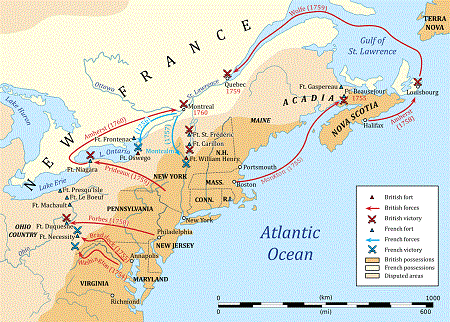
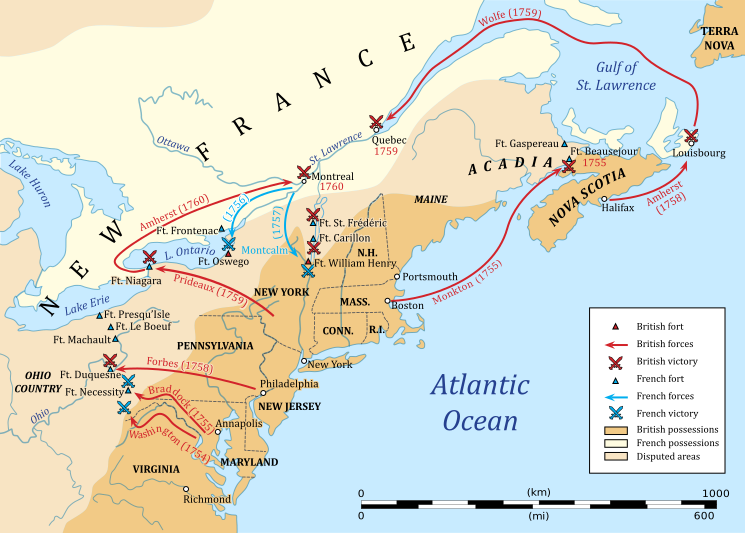
For several successive days the squadron of Holmes was allowed to drift up the river with the flood tide and down with the ebb, thus passing and repassing incessantly between the neighborhood of Quebec on one hand and a point high above Cap-Rouge on the other; while Bougainville, perplexed and always expecting an attack, followed the ships to and fro along the shore, by day and by night, till his men were exhausted with ceaseless forced marches.
[Joannès, Major de Quebec, Mémoire sur la Campagne de 1759.]
At last the time for action came. On Wednesday, the twelfth, the troops at St. Nicholas were embarked again and all were told to hold themselves in readiness. Wolfe, from the flagship “Sutherland,” issued his last general orders.
The enemy’s force is now divided, great scarcity of provisions in their camp and universal discontent among the Canadians. Our troops below are in readiness to join us; all the light artillery and tools are embarked at the Point of Levi; and the troops will land where the French seem least to expect it. The first body that gets on shore is to march directly to the enemy and drive them from any little post they may occupy; the officers must be careful that the succeeding bodies do not by any mistake fire on those who go before them. The battalions must form on the upper ground with expedition and be ready to charge whatever presents itself. When the artillery and troops are landed, a corps will be left to secure the landing-place, while the rest march on and endeavor to bring the Canadians and French to a battle. The officers and men will remember what their country expects from them and what a determined body of soldiers inured to war is capable of doing against five weak French battalions mingled with a disorderly peasantry.”
The spirit of the army answered to that of its chief. The troops loved and admired their general, trusted their officers and were ready for any attempt. “Nay, how could it be otherwise,” quaintly asks honest Sergeant John Johnson, of the fifty-eighth regiment, “being at the heels of gentlemen whose whole thirst, equal with their general, was for glory? We had seen them tried and always found them sterling. We knew that they would stand by us to the last extremity.”
Wolfe had thirty-six hundred men and officers with him on board the vessels of Holmes; and he now sent orders to Colonel Burton at Point Levi to bring to his aid all who could be spared from that place and the Point of Orleans. They were to march along the south bank, after nightfall and wait further orders at a designated spot convenient for embarkation. Their number was about twelve hundred, so that the entire forced destined for the enterprise was at the utmost forty-eight hundred.[1] With these, Wolfe meant to climb the heights of Abraham in the teeth of an enemy who, though much reduced, were still twice as numerous as their assailants.[2]
[1: See Note, end of chapter.]
[2: Including Bougainville’s command. An escaped prisoner told Wolfe, a few days before, that Montcalm still had fourteen thousand men. Journal of an Expedition on the River St. Lawrence. This meant only those in the town and the camps of Beauport. “I don’t believe their whole army amounts to that number,” wrote Wolfe to Colonel Burton, on the tenth. He knew, however, that if Montcalm could bring all his troops together, the French would outnumber him more than two to one.]
Admiral Saunders lay with the main fleet in the Basin of Quebec. This excellent officer, whatever may have been his views as to the necessity of a speedy departure, aided Wolfe to the last with unfailing energy and zeal. It was agreed between them that while the General made the real attack, the Admiral should engage Montcalm’s attention by a pretended one. As night approached, the fleet ranged itself along the Beauport shore; the boats were lowered and filled with sailors, marines and the few troops that had been left behind; while ship signaled to ship, cannon flashed and thundered and shot ploughed the beach, as if to clear a way for assailants to land. In the gloom of the evening the effect was imposing. Montcalm, who thought that the movements of the English above the town were only a feint, that their main force was still below it and that their real attack would be made there, was completely deceived and massed his troops in front of Beauport to repel the expected landing. But while in the fleet of Saunders all was uproar and ostentatious menace, the danger was ten miles away, where the squadron of Holmes lay tranquil and silent at its anchorage off Cap-Rouge.
It was less tranquil than it seemed. All on board knew that a blow would be struck that night, though only a few high officers knew where. Colonel Howe, of the light infantry, called for volunteers to lead the unknown and desperate venture, promising, in the words of one of them, “that if any of us survived we might depend on being recommended to the General.”[3] As many as were wanted — twenty-four in all — soon came forward. Thirty large bateaux and some boats belonging to the squadron lay moored alongside the vessels; and late in the evening the troops were ordered into them, the twenty-four volunteers taking their place in the foremost. They held in all about seventeen hundred men. The rest remained on board.
[3: Journal of the Particular Transactions during the Siege of Quebec. The writer, a soldier in the light infantry, says he was one of the first eight who came forward. See Notes and Queries, XX. 370.]
Bougainville could discern the movement and misjudged it, thinking that he himself was to be attacked. The tide was still flowing; and, the better to deceive him, the vessels and boats were allowed to drift upward with it for a little distance, as if to land above Cap-Rouge.
The day had been fortunate for Wolfe. Two deserters came from the camp of Bougainville with intelligence that, at ebb tide on the next night, he was to send down a convoy of provisions to Montcalm. The necessities of the camp at Beauport and the difficulties of transportation by land, had before compelled the French to resort to this perilous means of conveying supplies; and their boats, drifting in darkness under the shadows of the northern shore, had commonly passed in safety. Wolfe saw at once that, if his own boats went down in advance of the convoy, he could turn the intelligence of the deserters to good account.
He was still on board the “Sutherland.” Every preparation was made and every order given; it only remained to wait the turning of the tide. Seated with him in the cabin was the commander of the sloop-of-war “Porcupine,” his former school-fellow, John Jervis, afterwards Earl St. Vincent. Wolfe told him that he expected to die in the battle of the next day; and taking from his bosom a miniature of Miss Lowther, his betrothed, he gave it to him with a request that he would return it to her if the presentiment should prove true.
[Tucker, Life of Earl St. Vincent, I. 19. (London, 1844.)]
Towards two o’clock the tide began to ebb and a fresh wind blew down the river. Two lanterns were raised into the maintop shrouds of the “Sutherland.” It was the appointed signal; the boats cast off and fell down with the current, those of the light infantry leading the way. The vessels with the rest of the troops had orders to follow a little later.
To look for a moment at the chances on which this bold adventure hung. First, the deserters told Wolfe that provision-boats were ordered to go down to Quebec that night; secondly, Bougainville countermanded them; thirdly, the sentries posted along the heights were told of the order but not of the countermand;[4] fourthly, Vergor at the Anse du Foulon had permitted most of his men, chiefly Canadians from Lorette, to go home for a time and work at their harvesting, on condition, it is said, that they should afterwards work in a neighboring field of his own;[5] fifthly, he kept careless watch and went quietly to bed; sixthly, the battalion of Guienne, ordered to take post on the Plains of Abraham, had, for reasons unexplained, remained encamped by the St. Charles;[6] and lastly, when Bougainville saw Holmes’s vessels drift down the stream, he did not tax his weary troops to follow them, thinking that they would return as usual with the flood tide.[7] But for these conspiring circumstances New France might have lived a little longer and the fruitless heroism of Wolfe would have passed, with countless other heroisms, into oblivion.
[4: Journal tenu à l’Armée, etc.]
[5: Mémoires sur le Canada, 1749-1760.]
[6: Foligny, Journal mémoratif. Journal à l’Armée, etc.]
[7: Johnstone, Dialogue. Vaudreuil au Ministre, 5 Oct.1759.]
For full two hours the procession of boats, borne on the current, steered silently down the St. Lawrence. The stars were visible but the night was moonless and sufficiently dark. The General was in one of the foremost boats and near him was a young midshipman, John Robison, afterwards professor of natural philosophy in the University of Edinburgh. He used to tell in his later life how Wolfe, with a low voice, repeated Gray’s Elegy in a Country Churchyard to the officers about him. Probably it was to relieve the intense strain of his thoughts. Among the rest was the verse which his own fate was soon to illustrate, —
The paths of glory lead but to the grave.”
“Gentlemen,” he said, as his recital ended, “I would rather have written those lines than take Quebec.” None were there to tell him that the hero is greater than the poet.
As they neared their destination, the tide bore them in towards the shore and the mighty wall of rock and forest towered in darkness on their left. The dead stillness was suddenly broken by the sharp Qui vive! of a French sentry, invisible in the thick gloom. France! answered a Highland officer of Fraser’s regiment from one of the boats of the light infantry. He had served in Holland and spoke French fluently.
À quel régiment?
De la Reine, replied the Highlander. He knew that a part of that corps was with Bougainville. The sentry, expecting the convoy of provisions, was satisfied and did not ask for the password.
Soon after, the foremost boats were passing the heights of Samos, when another sentry challenged them and they could see him through the darkness running down to the edge of the water, within range of a pistol-shot. In answer to his questions, the same officer replied, in French: “Provision-boats. Don’t make a noise; the English will hear us.”[8] In fact, the sloop-of-war “Hunter” was anchored in the stream not far off. This time, again, the sentry let them pass. In a few moments they rounded the headland above the Anse du Foulon. There was no sentry there. The strong current swept the boats of the light infantry a little below the intended landing-place.[9] They disembarked on a narrow strand at the foot of heights as steep as a hill covered with trees can be. The twenty-four volunteers led the way, climbing with what silence they might, closely followed by a much larger body. When they reached the top they saw in the dim light a cluster of tents at a short distance and immediately made a dash at them. Vergor leaped from bed and tried to run off but was shot in the heel and captured. His men, taken by surprise, made little resistance. One or two were caught, the rest fled.
[8: See a note of Smollett, History of England, V. 56 (ed. 1805). Sergeant Johnson, Vaudreuil, Foligny and the Journal of Particular Transactions give similar accounts.]
[9: Saunders to Pitt, 20 Sept. Journal of Sergeant Johnson. Compare Knox, II. 67.]
From Montcalm and Wolfe, Chapter 27 by Francis Parkman
The below is from Francis Parkman’s Preface to this book.
A very large amount of unpublished material has been used in its preparation, consisting for the most part of documents copied from the archives and libraries of France and England, especially from the Archives de la Marine et des Colonies, the Archives de la Guerre, and the Archives Nationales at Paris, and the Public Record Office and the British Museum at London. The papers copied for the present work in France alone exceed six thousand folio pages of manuscript, additional and supplementary to the “Paris Documents” procured for the State of New York under the agency of Mr. Brodhead. The copies made in England form ten volumes, besides many English documents consulted in the original manuscript. Great numbers of autograph letters, diaries, and other writings of persons engaged in the war have also been examined on this side of the Atlantic.
I owe to the kindness of the present Marquis de Montcalm the permission to copy all the letters written by his ancestor, General Montcalm, when in America, to members of his family in France. General Montcalm, from his first arrival in Canada to a few days before his death, also carried on an active correspondence with one of his chief officers, Bourlamaque, with whom he was on terms of intimacy. These autograph letters are now preserved in a private collection. I have examined them and obtained copies of the whole. They form an interesting complement to the official correspondence of the writer, and throw the most curious side-lights on the persons and events of the time.
Besides manuscripts, the printed matter in the form of books, pamphlets, contemporary newspapers, and other publications relating to the American part of the Seven Years’ War, is varied and abundant; and I believe I may safely say that nothing in it of much consequence has escaped me. The liberality of some of the older States of the Union, especially New York and Pennsylvania, in printing the voluminous records of their colonial history, has saved me a deal of tedious labor.
The whole of this published and unpublished mass of evidence has been read and collated with extreme care, and more than common pains have been taken to secure accuracy of statement. The study of books and papers, however, could not alone answer the purpose. The plan of the work was formed in early youth; and though various causes have long delayed its execution, it has always been kept in view. Meanwhile, I have visited and examined every spot where events of any importance in connection with the contest took place, and have observed with attention such scenes and persons as might help to illustrate those I meant to describe. In short, the subject has been studied as much from life and in the open air as at the library table.
BOSTON, Sept. 16, 1884.
MORE INFORMATION
TEXT LIBRARY
- Here’s a free download of this book from Gutenberg.
- Overview of these conflicts.
- Military of New France.
- French Explorers of North America
MAP LIBRARY
Because of lack of detail in maps as embedded images, we are providing links instead, enabling readers to view them full screen.


Other books of this series here at History Moments
Leave a Reply
You must be logged in to post a comment.