As fast as the boats were emptied they returned for the troops left on board the vessels and for those waiting on the southern shore.
Our special project presenting the definitive account of France in Canada by Francis Parkman, one of America’s greatest historians.
Previously in Montcalm and Wolfe, Volume 7 of the French in Canada series. Continuing Chapter 27.
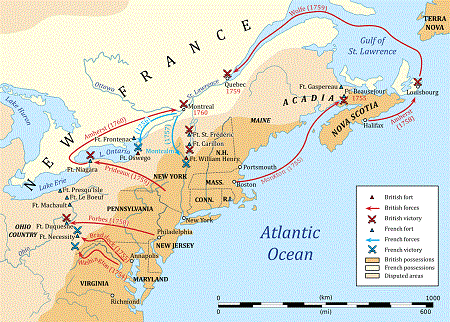
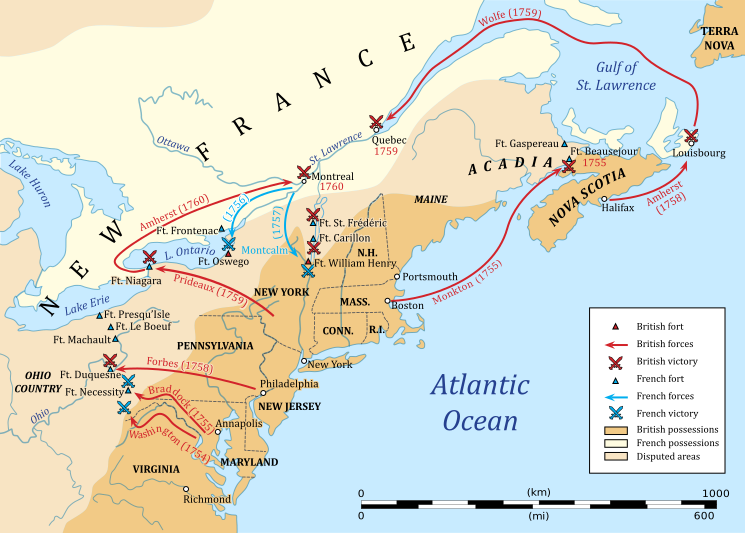
The main body of troops waited in their boats by the edge of the strand. The heights near by were cleft by a great ravine choked with forest trees; and in its depths ran a little brook called Ruisseau St.-Denis, which, swollen by the late rains, fell plashing in the stillness over a rock. Other than this no sound could reach the strained ear of Wolfe but the gurgle of the tide and the cautious climbing of his advance-parties as they mounted the steeps at some little distance from where he sat listening. At length from the top came a sound of musket-shots, followed by loud huzzas and he knew that his men were masters of the position. The word was given; the troops leaped from the boats and scaled the heights, some here, some there, clutching at trees and bushes, their muskets slung at their backs. Tradition still points out the place, near the mouth of the ravine, where the foremost reached the top. Wolfe said to an officer near him: “You can try it but I don’t think you’ll get up.” He himself, however, found strength to drag himself up with the rest. The narrow slanting path on the face of the heights had been made impassable by trenches and abattis; but all obstructions were soon cleared away and then the ascent was easy. In the gray of the morning the long file of red-coated soldiers moved quickly upward and formed in order on the plateau above.
Before many of them had reached the top, cannon were heard close on the left. It was the battery at Samos firing on the boats in the rear and the vessels descending from Cap-Rouge. A party was sent to silence it; this was soon effected and the more distant battery at Sillery was next attacked and taken. As fast as the boats were emptied they returned for the troops left on board the vessels and for those waiting on the southern shore under Colonel Burton.
The day broke in clouds and threatening rain. Wolfe’s battalions were drawn up along the crest of the heights. No enemy was in sight, though a body of Canadians had sallied from the town and moved along the strand towards the landing-place, whence they were quickly driven back. He had achieved the most critical part of his enterprise; yet the success that he coveted placed him in imminent danger. On one side was the garrison of Quebec and the army of Beauport and Bougainville was on the other. Wolfe’s alternative was victory or ruin; for if he should be overwhelmed by a combined attack, retreat would be hopeless. His feelings no man can know; but it would be safe to say that hesitation or doubt had no part in them.
He went to reconnoiter the ground and soon came to the Plains of Abraham, so called from Abraham Martin, a pilot known as Maître Abraham, who had owned a piece of land here in the early times of the colony. The Plains were a tract of grass, tolerably level in most parts, patched here and there with cornfields, studded with clumps of bushes and forming a part of the high plateau at the eastern end of which Quebec stood. On the south it was bounded by the declivities along the St. Lawrence; on the north, by those along the St. Charles, or rather along the meadows through which that lazy stream crawled like a writhing snake. At the place that Wolfe chose for his battle-field the plateau was less than a mile wide.
Thither the troops advanced, marched by files till they reached the ground and then wheeled to form their line of battle, which stretched across the plateau and faced the city. It consisted of six battalions and the detached grenadiers from Louisbourg, all drawn up in ranks three deep. Its right wing was near the brink of the heights along the St. Lawrence; but the left could not reach those along the St. Charles. On this side a wide space was perforce left open and there was danger of being outflanked. To prevent this, Brigadier Townshend was stationed here with two battalions, drawn up at right angles with the rest and fronting the St. Charles. The battalion of Webb’s regiment, under Colonel Burton, formed the reserve; the third battalion of Royal Americans was left to guard the landing; and Howe’s light infantry occupied a wood far in the rear. Wolfe, with Monckton and Murray, commanded the front line, on which the heavy fighting was to fall and which, when all the troops had arrived, numbered less than thirty-five hundred men.
[See Note, end of chapter.]
Quebec was not a mile distant but they could not see it; for a ridge of broken ground intervened, called Buttes-à-Neveu, about six hundred paces off. The first division of troops had scarcely come up when, about six o’clock, this ridge was suddenly thronged with white uniforms. It was the battalion of Guienne, arrived at the eleventh hour from its camp by the St. Charles. Some time after there was hot firing in the rear. It came from a detachment of Bougainville’s command attacking a house where some of the light infantry were posted. The assailants were repulsed and the firing ceased. Light showers fell at intervals, besprinkling the troops as they stood patiently waiting the event.
Montcalm had passed a troubled night. Through all the evening the cannon bellowed from the ships of Saunders and the boats of the fleet hovered in the dusk off the Beauport shore, threatening every moment to land. Troops lined intrenchments till day, while the General walked the field that adjoined his headquarters till one in the morning, accompanied by the Chevalier Johnstone and Colonel Poulariez. Johnstone says that he was in great agitation and took no rest all night. At daybreak he heard the sound of cannon above the town. It was the battery at Samos firing on the English ships. He had sent an officer to the quarters of Vaudreuil, which were much nearer Quebec, with orders to bring him word at once should anything unusual happen. But no word came and about six o’clock he mounted and rode thither with Johnstone. As they advanced, the country behind the town opened more and more upon their sight; till at length, when opposite Vaudreuil’s house, they saw across the St. Charles, some two miles away, the red ranks of British soldiers on the heights beyond.
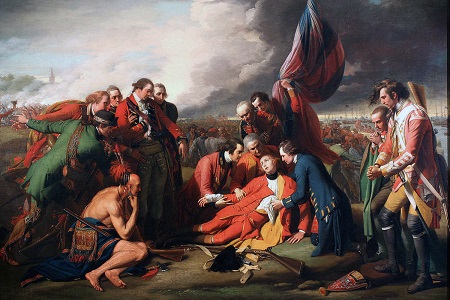
“This is a serious business,” Montcalm said; and sent off Johnstone at full gallop to bring up the troops from the center and left of the camp. Those of the right were in motion already, doubtless by the Governor’s order. Vaudreuil came out of the house. Montcalm stopped for a few words with him; then set spurs to his horse and rode over the bridge of the St. Charles to the scene of danger.[1] He rode with a fixed look, uttering not a word.[2]
[1: Johnstone, Dialogue.]
[2: Malartic à Bourlamaque, — Sept. 1759.]
The army followed in such order as it might, crossed the bridge in hot haste, passed under the northern rampart of Quebec, entered at the Palace Gate and pressed on in headlong march along the quaint narrow streets of the warlike town: troops of Indians in scalp-locks and war-paint, a savage glitter in their deep-set eyes; bands of Canadians whose all was at stake, — faith, country and home; the colony regulars; the battalions of Old France, a torrent of white uniforms and gleaming bayonets, La Sarre, Languedoc, Roussillon, Béarn, — victors of Oswego, William Henry and Ticonderoga. So they swept on, poured out upon the plain, some by the gate of St. Louis and some by that of St. John and hurried, breathless, to where the banners of Guienne still fluttered on the ridge.
Montcalm was amazed at what he saw. He had expected a detachment and he found an army. Full in sight before him stretched the lines of Wolfe: the close ranks of the English infantry, a silent wall of red and the wild array of the Highlanders, with their waving tartans and bagpipes screaming defiance. Vaudreuil had not come; but not the less was felt the evil of a divided authority and the jealousy of the rival chiefs. Montcalm waited long for the forces he had ordered to join him from the left wing of the army. He waited in vain. It is said that the Governor had detained them, lest the English should attack the Beauport shore. Even if they did so and succeeded, the French might defy them, could they but put Wolfe to rout on the Plains of Abraham. Neither did the garrison of Quebec come to the aid of Montcalm. He sent to Ramesay, its commander, for twenty-five field-pieces which were on the Palace battery. Ramesay would give him only three, saying that he wanted them for his own defense. There were orders and counter-orders; misunderstanding, haste, delay, perplexity.
Montcalm and his chief officers held a council of war. It is said that he and they alike were for immediate attack. His enemies declare that he was afraid lest Vaudreuil should arrive and take command; but the Governor was not a man to assume responsibility at such a crisis. Others say that his impetuosity overcame his better judgment; and of this charge it is hard to acquit him. Bougainville was but a few miles distant and some of his troops were much nearer; a messenger sent by way of Old Lorette could have reached him in an hour and a half at most and a combined attack in front and rear might have been concerted with him. If, moreover, Montcalm could have come to an understanding with Vaudreuil, his own force might have been strengthened by two or three thousand additional men from the town and the camp of Beauport; but he felt that there was no time to lose, for he imagined that Wolfe would soon be reinforced, which was impossible and he believed that the English were fortifying themselves, which was no less an error. He has been blamed not only for fighting too soon but for fighting at all. In this he could not choose. Fight he must, for Wolfe was now in a position to cut off all his supplies. His men were full of ardor and he resolved to attack before their ardor cooled. He spoke a few words to them in his keen, vehement way. “I remember very well how he looked,” one of the Canadians, then a boy of eighteen, used to say in his old age; “he rode a black or dark bay horse along the front of our lines, brandishing his sword, as if to excite us to do our duty. He wore a coat with wide sleeves, which fell back as he raised his arm and showed the white linen of the wristband.”
[Recollections of Joseph Trahan, in Revue Canadienne, IV.]
The English waited the result with a composure which, if not quite real, was at least well feigned. The three field-pieces sent by Ramesay plied them with canister-shot and fifteen hundred Canadians and Indians fusilladed them in front and flank. Over all the plain, from behind bushes and knolls and the edge of cornfields, puffs of smoke sprang incessantly from the guns of these hidden marksmen. Skirmishers were thrown out before the lines to hold them in check and the soldiers were ordered to lie on the grass to avoid the shot. The firing was liveliest on the English left, where bands of sharpshooters got under the edge of the declivity, among thickets and behind scattered houses, whence they killed and wounded a considerable number of Townshend’s men. The light infantry were called up from the rear. The houses were taken and retaken and one or more of them was burned.
Wolfe was everywhere. How cool he was and why his followers loved him, is shown by an incident that happened in the course of the morning. One of his captains was shot through the lungs; and on recovering consciousness he saw the General standing at his side. Wolfe pressed his hand, told him not to despair, praised his services, promised him early promotion and sent an aide-de-camp to Monckton to beg that officer to keep the promise if he himself should fall.
[Sir Denis Le Marchant, cited by Wright, 579. Le Marchant knew the captain in his old age. Monckton kept Wolfe’s promise.]
From Montcalm and Wolfe, Chapter 27 by Francis Parkman
The below is from Francis Parkman’s Preface to this book.
A very large amount of unpublished material has been used in its preparation, consisting for the most part of documents copied from the archives and libraries of France and England, especially from the Archives de la Marine et des Colonies, the Archives de la Guerre, and the Archives Nationales at Paris, and the Public Record Office and the British Museum at London. The papers copied for the present work in France alone exceed six thousand folio pages of manuscript, additional and supplementary to the “Paris Documents” procured for the State of New York under the agency of Mr. Brodhead. The copies made in England form ten volumes, besides many English documents consulted in the original manuscript. Great numbers of autograph letters, diaries, and other writings of persons engaged in the war have also been examined on this side of the Atlantic.
I owe to the kindness of the present Marquis de Montcalm the permission to copy all the letters written by his ancestor, General Montcalm, when in America, to members of his family in France. General Montcalm, from his first arrival in Canada to a few days before his death, also carried on an active correspondence with one of his chief officers, Bourlamaque, with whom he was on terms of intimacy. These autograph letters are now preserved in a private collection. I have examined them and obtained copies of the whole. They form an interesting complement to the official correspondence of the writer, and throw the most curious side-lights on the persons and events of the time.
Besides manuscripts, the printed matter in the form of books, pamphlets, contemporary newspapers, and other publications relating to the American part of the Seven Years’ War, is varied and abundant; and I believe I may safely say that nothing in it of much consequence has escaped me. The liberality of some of the older States of the Union, especially New York and Pennsylvania, in printing the voluminous records of their colonial history, has saved me a deal of tedious labor.
The whole of this published and unpublished mass of evidence has been read and collated with extreme care, and more than common pains have been taken to secure accuracy of statement. The study of books and papers, however, could not alone answer the purpose. The plan of the work was formed in early youth; and though various causes have long delayed its execution, it has always been kept in view. Meanwhile, I have visited and examined every spot where events of any importance in connection with the contest took place, and have observed with attention such scenes and persons as might help to illustrate those I meant to describe. In short, the subject has been studied as much from life and in the open air as at the library table.
BOSTON, Sept. 16, 1884.
MORE INFORMATION
TEXT LIBRARY
- Here’s a free download of this book from Gutenberg.
- Overview of these conflicts.
- Military of New France.
- French Explorers of North America
MAP LIBRARY
Because of lack of detail in maps as embedded images, we are providing links instead, enabling readers to view them full screen.


Other books of this series here at History Moments
Leave a Reply
You must be logged in to post a comment.